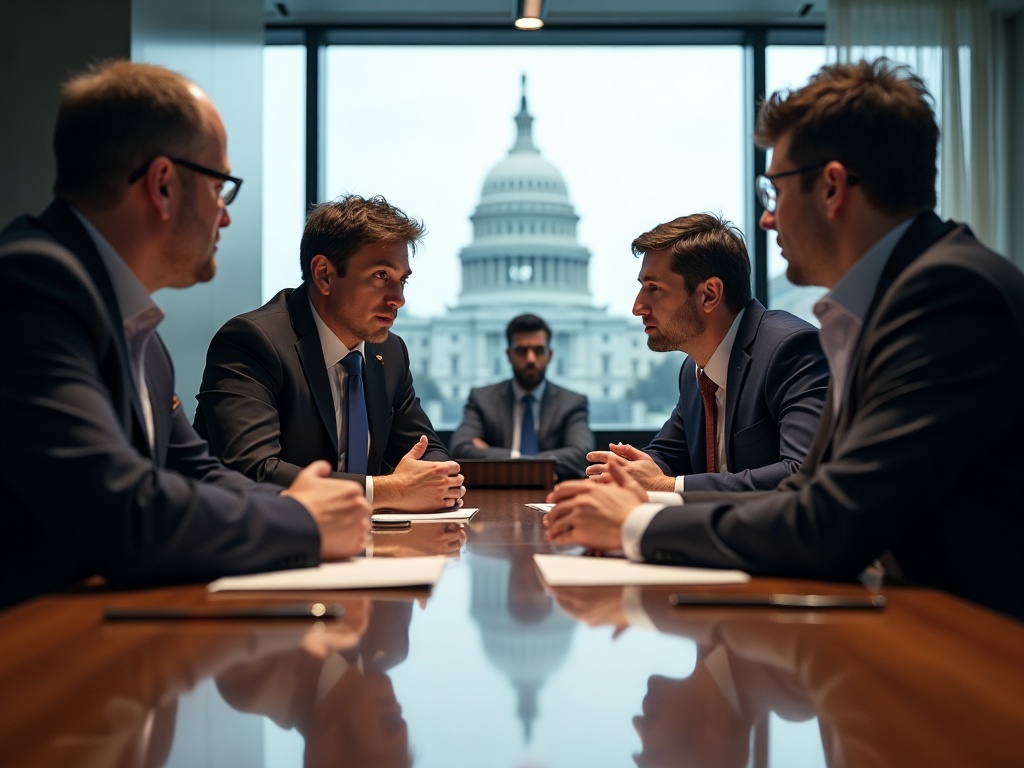
In early June, President Donald Trump signed a pivotal executive order aimed at advancing artificial intelligence (AI) innovation and security. The directive set a deadline of 60 days for federal agencies to develop a framework critical to its implementation, with the due date looming this coming Saturday, August 1. As anticipation builds across Silicon Valley, the debate surrounding AI regulation has intensified, drawing significant attention from industry leaders and policymakers.
Among those deeply involved in discussions this week in Washington, D.C., were Sam Altman, CEO of OpenAI, and Nvidia’s Jensen Huang. Their presence underscores the urgency with which the tech industry seeks to influence the upcoming regulatory decisions. Trump’s executive order, noted for its lack of detail, requests AI companies to voluntarily submit their models for government evaluation prior to public release. This has sparked discussions on the specifics, expected to be ironed out by key figures such as Treasury Secretary Scott Bessent, Defense Secretary Pete Hegseth, and White House Chief of Staff Susie Wiles.
When questioned on the progress of the framework, the White House directed attention to a social media post from spokesperson Kush Desai, indicating their confidence in meeting the self-imposed deadline. Meanwhile, representatives from OpenAI and Anthropic have yet to respond to requests for comment. Altman mentioned in a CNBC interview that he has reviewed a draft of the framework but expressed no immediate need for changes, following his meeting with Wiles and anticipated discussions with Bessent and Lutnick.
This deadline arrives amidst a period of heightened tension in U.S. AI development. The burgeoning presence of cost-effective open-weight models from China has rattled the market, challenging established players like OpenAI and Anthropic. These open-weight models, allowing users to modify and run them on diverse infrastructures, have incited a fierce debate over potential restrictions or bans, sparking unified opposition from global tech executives.
Nvidia’s Jensen Huang inflamed the discussion earlier this week by advocating against “premature restrictions” on open-weight models through a publicly released letter, gaining support from figures like Elon Musk and major corporations including Microsoft, Meta, and Palantir. Despite this, the Trump administration has yet to declare its stance, though prominent figures like former AI czar David Sacks have been vocal against any bans.
The executive order suggests that the AI framework will entail a classified benchmarking process to assess models’ cybersecurity capabilities, determining whether they qualify as “covered frontier models.” It aims to foster collaboration between the government and private sector to establish “trusted partners” who will access these models.
The upcoming finalized framework could clarify the murky regulatory landscape that companies have navigated since the order’s signing. Both Anthropic and OpenAI have made strategic model deployments under governmental directives, reflecting the complex interplay between innovation and regulation. Chief of Staff Wiles highlighted the unprecedented cooperation between the government and private sector, emphasizing a mutual commitment to swiftly and safely deploying advanced technologies.
The ongoing developments in AI regulation highlight a critical juncture for the tech industry, as stakeholders await the framework that could significantly shape the trajectory of AI deployment and governance.
You can read the original article here: https://www.cnbc.com/2026/07/31/trump-ai-executive-order-nears-key-deadline-regulation-debate-heats-up.html