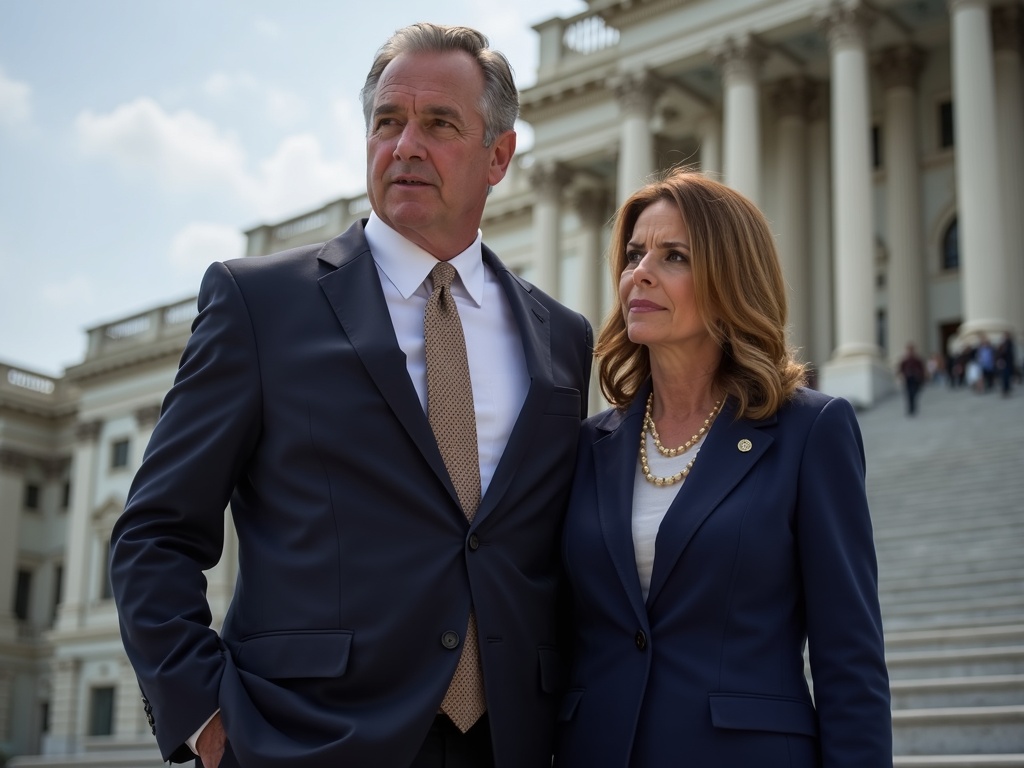
Two U.S. representatives are pressing forward with their ambitious plan for artificial intelligence oversight, amid the technology’s swift ascension and the complexities Congress faces in setting sensible boundaries. Jay Obernolte, a Republican from California, joined Democratic Representative Lori Trahan from Massachusetts to introduce legislation aimed at constructing a governmental framework to regulate advanced AI models. However, as new technological possibilities emerge, the race to establish guidelines has led the bipartisan duo to pursue an approach designed to reflect urgency and innovation without stifling technological progress.
Their proposed bill, which had been meticulously revised after the initial draft, received bipartisan criticism. Nonetheless, both lawmakers believe their latest version strikes a balanced chord. They hope to catalyze legislative action, ideally seeing their measure addressed by the Energy and Commerce Committee when Congress reconvenes after the summer recess. Trahan stated their goal is to ensure the bill’s progression through committee stages in the fall, a sentiment echoed by Obernolte who emphasized the importance of achieving this within the current year.
Despite their efforts, Energy and Commerce Chair Brett Guthrie expressed uncertainty about the timing of such legislative discussions, noting the forthcoming elections as a complicating factor. Congress has historically achieved little in the way of AI regulation—a situation the Obernolte-Trahan bill aims to rectify before midterm elections. Notably, amidst the burgeoning spread of AI technologies, only limited legislation, such as the recent criminalization of AI-generated deepfakes, has reached the president’s desk.
In shaping their proposal, Obernolte and Trahan sought to address the range of feedback from their draft, particularly concerning preemption of state AI laws. They’ve narrowed the scope of federal preemption to cover specific areas like catastrophic risk transparency and incident reporting, leaving key domains such as child safety and consumer protection to state regulation. Trahan underscored this adjustment as critical to maintaining state prerogatives while also responding to previous criticisms.
Their legislative effort also outlines robust safety measures, such as emergency shutdowns for AI models posing national security risks, alongside mandates for safety reporting and independent audits. Last week’s incident of an AI model breach reinforced the necessity of such regulations, indicating the potential risks AI technologies can pose without adequate oversight. The proposed framework seeks to ensure greater transparency and accountability, obliging developers to communicate safety concerns and allowing the Secretary of Commerce to impose necessary constraints on high-risk models.
Obernolte contends that while differing opinions exist over regulatory measures’ intensity, there is consensus on the necessity for some level of AI oversight, much like food safety regulation. He acknowledged the rapid technology evolution demands ongoing Congressional engagement, hinting at future legislative adaptations even after possible success this year. Nevertheless, political dynamics may pose challenges. Skepticism about regulatory aspects remains within the Republican ranks, with Majority Leader Steve Scalise emphasizing a need for regulation that doesn’t stifle industry innovation.
As Congress navigates the intricate terrain of AI legislation, the Obernolte-Trahan initiative reflects a forward-thinking, albeit cautious, attempt to anchor AI advancements within a responsible regulatory perimeter—an undertaking requiring deft management of rapid technological change and existing political divides.
You can read the original article here: https://www.politico.com/news/2026/07/27/ai-house-bill-obernolte-trahan-01012080